
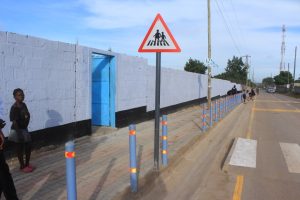
Lusaka, Zambia, made significant progress in enhancing road safety, especially for children walking to school. In 2015, road traffic crashes in Zambia resulted in over 3,500 deaths; with pedestrians accounting for more than a third of those fatalities, many of which occurred in Lusaka. More than 70% of school-age children walk to school each day, often on streets that lack safe infrastructure. In 2018, for example, 181 Zambian children under 16 lost their lives in traffic accidents nationwide. In 2017, Lusaka became part of the Partnership for Healthy Cities, a global network that helps cities prevent injuries and noncommunicable diseases, focusing on road safety measures. The city took action to improve traffic safety near two high-risk schools, in collaboration with the Ministries of Education and Transport and Amend, a road safety organization. By September 2018, the city had installed crosswalks, speed bumps, and sidewalks near these two schools. This reduced average vehicle speeds from 38 km/h to 12 km/h at one school, and from 22 km/h to 18 km/h at the other. Lusaka later extended the program to two more schools in partnership with the Zambia Road Safety Trust, adding painted crossings, signage, and other safety features. In December 2019, urban speed limits across Zambia were reduced from 40 km/h to 30 km/h. This local initiative in Lusaka illustrates how environmental change efforts can further promote safe travel especially for school children.
SOURCE: World. “Lusaka: Reducing Speeding near Schools.” Who.int, World Health Organization: WHO, 26 Oct. 2021, www.who.int/news-room/feature-stories/detail/lusaka-reducing-speeding-near-schools .
For Further Information: